

Re-entry of exhausted air can cause serious problems: how CFD simulation can help
The performance of the ventilation system in livestock carriers represents a key factor for animal welfare during long overseas transports.
Australia has set the highest standards for livestock transport (ASEL, Australian Standards for the Export of Livestock), outlining the minimum animal health and welfare conditions exporters must meet. The standards required by the Australian Maritime Safety Authority in AMSA MO43 represent a reference for this industry to comply with in designing livestock carriers, as presented by A. Schultz-Altmann.
Voyages can last up to 2-3 weeks for typical trading routes crossing the equator, where heat stress events can potentially occur, representing a serious threat for the animals on board. As it has already been presented in this article, CFD simulations can be used for the design and optimization of these ventilation systems, improving performance, reducing operating costs, but most importantly increasing animal welfare.
The total amount of air supplied by the ventilation system in a livestock carrier does not necessarily correspond to the effective amount of “fresh air” supplied, as part of the total air supply might be contaminated by pollutant gases (CO2, NH3, water vapor…) expelled by the same livestock carrier. Therefore, we meet another relevant problem: the re-emission of pollutant gases into the ship’s environment.
Re-ingestion phenomenon
The re-ingestion of pollutant gases (rich in CO2, NH3, water vapour…) into the ventilation flow occurs when the supply ducts introduce into the vessel’s environment not only fresh air, but also polluted air from the ship.
The re-ingestion phenomenon is especially evident in livestock carriers with open deck design: a consistent fraction of polluted air, flowing out of the open decks at low velocity, can easily form a plume of contaminated air surrounding the vessel and can be re-ingested by supply fans located on the sundeck.
This phenomenon does not represent an important issue during sailing, when the presence of crosswind can rapidly dilute pollutants, but in calm wind conditions, which typically occur in Middle East ports during discharging of livestock. The following figure shows a simple sketch describing the re-ingestion phenomenon for a livestock carrier with 4 open decks and 5 enclosed decks, located below them. Supply fans are located close to the centerline of the vessel, while exhaust fans from enclosed decks are located at both sides of the vessels.
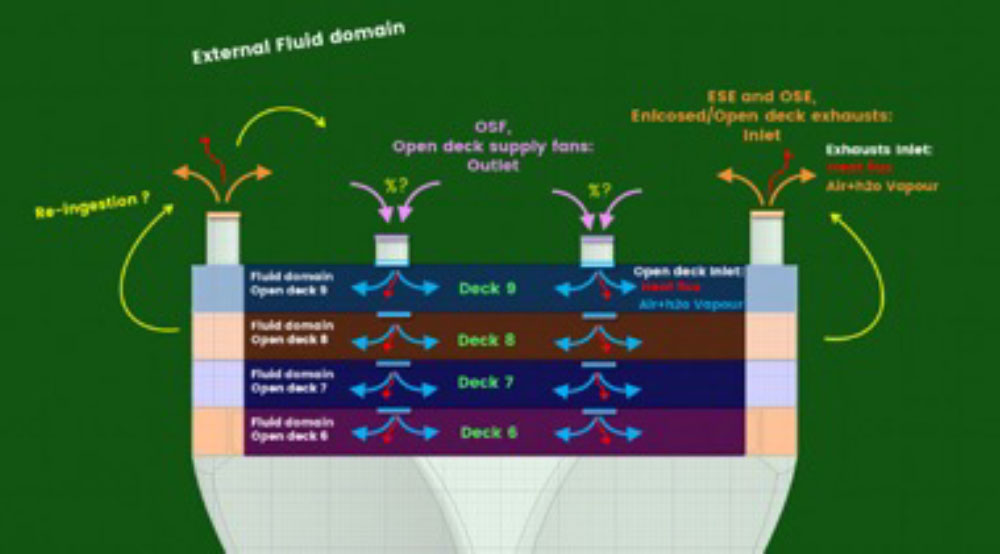
Polluted air from open decks flows slowly toward both sides of the vessel, then it rises due to buoyancy, as exhaust air is generally warmer. This polluted air can partially be diluted in the area surrounding the vessel or be attracted by the supply fans located on the sundeck: a fraction of the air supplied might therefore be polluted, effectively de-rating the ventilation performance of the vessel.
How CFD simulation can improve ventilation performance
To quantify the precise amount of re-ingested air, CFD represents the only viable solution to reproduce the fluid flow surrounding a livestock carrier. Tracking smoke particles from the exhausts is not practicable, due to the difficulty of controlling several environmental conditions, and the size of these vessels.
A numerical model simulating the physical phenomenon of re-ingestion of exhaust air was built in ANSYS CFX 19 using a simplified geometry of the vessel, where the most important geometric details are represented.
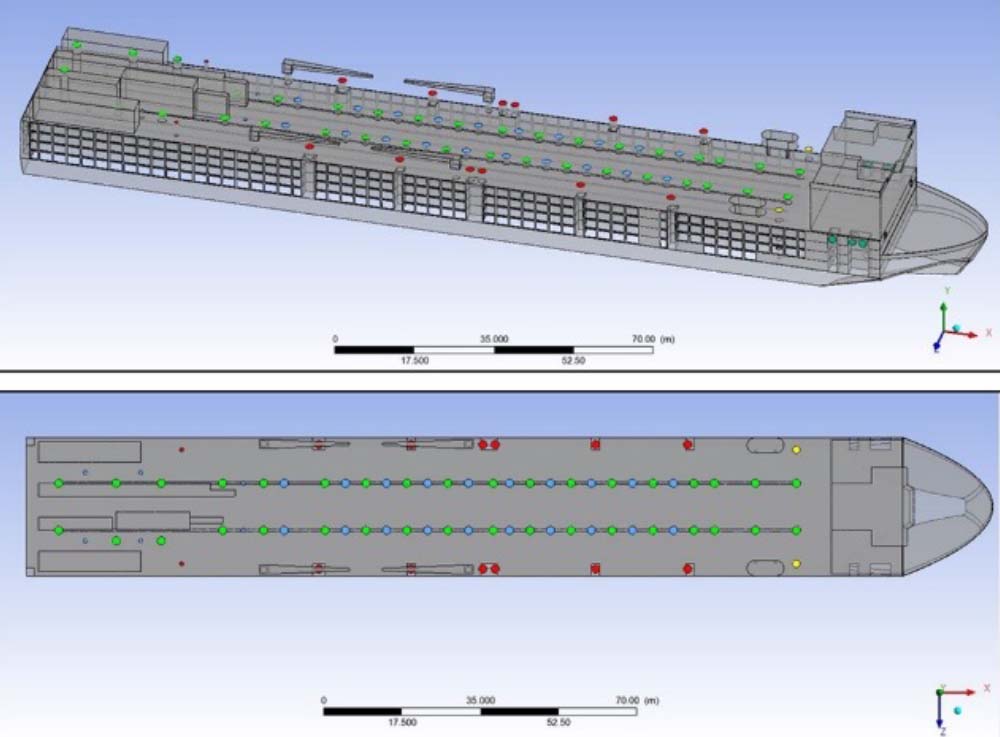
The CFD model was built to simulate the physics of exhaust gases, considering:
- flow generated by supply and exhaust fans of the vessel (about 90 fans in total);
- dispersion of pollutants;
- buoyancy effects generated by different densities of the gases and due to temperature gradients
If you want to learn more, download our paper presented during CAE Conference in Vicenza (Italy) in 2021.
Software: ANSYS CFX 19
Author: Alessio Mai